
How Good is Good?
In September design felt impotent and frivolous. There is nothing inherent in our profession that forces us to support worthy causes, to promote good things, to avoid visual pollution. There might be such a responsibility in us as people. In August, when thinking about my reasons for being alive, for getting out of bed in the morning, I would have written the following down.
1. Strive for happiness
2. Don’t hurt anybody
3. Help, others achieve the same
Now I would change that priority:
1. Help others
2. Don’t hurt anybody
3. Strive for happiness
My studio was engaged in cool projects, things designers like to do, like designing a cover for David Byrne
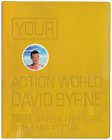
We had a good time designing them, and since the products and events these pieces promoted were fine, I don’t think we hurt anybody who bought them.
One of the many things I learned in my year without clients, a year I had put aside for experiments only, was that I’d like a part of my studio to move from creating cool things to significant things.
The 80s in graphic design were dominated by questions about the layout, by life style magazines, with Neville Brody’s Face seen as the big event. The 90s were dominated by questions about typography, readability, layering, with David Carson emerging as the dominant figure.
With prominent figures like Peter Saville recently talking about the crisis of the unnecessary and lamenting about the fact that our contemporary culture is monthly, there might now finally be room for content, for questions about what we do and for whom we are doing it. The incredible impact the First Things First manifesto had on my profession would certainly point in that direction.
The first sentence on page 1 of Victor Papanek’s “Design for the Real World” reads: “There are professions more harmful than industrial design, but only very few of them. And possibly only one profession is phonier: Advertising design. In persuading people to buy things they don’t need, with money they don’t have, in order to impress others that don’t care, it is probably the phoniest field in existence today.”
I do know that bad design can harm our lives. From the problems this little piece of bad typography caused in Florida to unnecessary junk mail and overproduced packaging, bad design makes the world a more difficult place to live in.
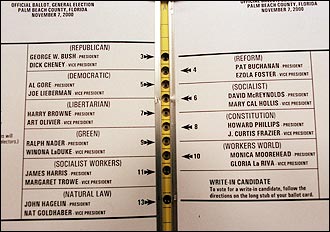
At the same time, strong design for bad causes or products can hurt us even more.
Good design + bad cause = bad

Just consider this age old and powerful symbol symbol and its transformation into a very successful identity program by the Nazis.

Context is all-important: The Christian cross had one meaning in 16th century Europe and another one in 20th century India.
Bad design + good cause = good?
On the other hand, bad design for a good cause can still be a good thing. We designed the logo for The Concert for New York, a huge charity event for the fire and policeman in Madison Square Garden, involving among others Paul McCartney, Mick Jagger, The Who.

From a design point of view, the statue of liberty playing a guitar is a trite cliché. I am not suggesting that the logo had much to do with the over $ 20 million raised for the Robin Hood Foundation, well, actually, a tiny portion was raised through the logo in the from of merchandize sales.
[signup]
How to be good?
Well, does help by definition have to be selfless? Am I allowed to get something out of myself? If I do help, am I permitted to have fun while doing so?
I read an interview with an art director in England discussing his award winning campaign ad campaign for an association for the blind, featuring a striking image of a guide dog with human eyes stripped in.
He mentioned that he knew that a picture of a cute puppy would have raised more donations for the association, but was more interested in winning awards. He had no problems with this attitude.
When GE gives 10 million to the WTC victim families, is it ok for them to look good for doing so?
Or, a more extreme case: Is it ok for Philip Morris to go and give 60 million to help out various charities and then spend another 108 million promoting this good deed in magazine ads?
If you are homeless and you just got a hot meal from St. Johns in Brooklyn, one of the organizations the money went to, you don’t really give a shit if the people who gave it to you tout their own horn afterwards.
Even though it really is a ridiculous case, isn’t it still preferable to blowing the entire 168 million on a regular ad budget?
And: Why are so many celebrities involved in charities?
Five years ago, my feeling was they just wanted to promote their careers. Now I am somewhat less cynical. It is conceivable that many simply came to realize the pursuit of money/fame/success does not hold the contentment it promised and are on the lookout for more significance.

Poor Sting practically ruined his career with all his do gooding, transforming himself from the cool leader of the Police to just another sappy rain forest bard

Where do the critics come in? If I make fun of Sting, do I keep other celebrities from following his lead and therefore somehow contribute to the destruction of the rainforest? If I do criticize Sting, do I have to have a better idea to help the world?
When philosopher Edward DeBono talks about values, he puts them into four equally important sections:
Me-values: ego and pleasure
Mates-values: belonging to a group, not letting it down
Moral-values: religious values, general law, general values of a particular culture
Mankind-values: human rights, ecology
I often make the mistake of concentrating on just a couple of these values in my life. We all have heard of the philanthropist who gave away millions to charity and was a genuine asshole to all his friends. Or the guy who is totally devoted to his family and friends but hates himself, drives a Suburban and works for a Nuclear Missile Plant.
Or Mr. Bin Laden himself: I am sure he is totally devoted to his religious values as well as to the values of his own culture, but does not really care about human rights much.
For a full life I would have to be involved in all four.
I do think there is a role for everyone. It does not really matter if I am the Mayor of New York, or if I design the tourist brochures for New York or if I sweep the streets in New York. There is always room to be nice to a co-worker, to send a sweet letter to Mom, to love Anni.
Of course there are different degrees of separation. The rescue worker down at Ground Zero is directly involved, when I design a pin to raise money to help the rescue worker, I’m a couple of degrees further removed. But I might just function twice as effective as a designer than I would as a rescue worker.
Well, while pondering those questions half a year ago, I got invited to participate in a media design exhibition in Vienna, Austria. One of the perks that came with the exhibit was a free, full-page ad in Austria’s best newspaper, space I was free to fill with whatever I liked.
It’s an idea for a packaging that might be applied in zones of large catastrophes, earthquakes and such. At the time I was naively thinking of far away locations, India or Africa, not for a second conceiving that my hometown New York itself might be turned into the largest catastrophe zone.
It is basically a large, hollow Lego like block containing basic foods like milk powder, water, dried fish, rice. After the food has been consumed, the empty packaging can be filled with sand or dirt and used as an interlocking brick to build a shelter.
In the ad I explained the idea and asked other designers, packaging manufacturers and aid organizations to contribute.
Responses came into my laptop immediately. Many from students who just wanted to help, some from Austrian packaging companies interested in participating and many from designers and architects offering ideas.
Also, it was an opportunity to feel and look good myself: The caring designer.
Among all the positive responses was also a violently negative one;
- the writer stating that this is the absolute worst idea he ever saw in this context, that it’s a case of designing poverty, just plain ignorant and stupid.
I got really nervous. I am just not used to having my work hated that much. Maybe I should have stuck to CD covers.
The e-mail did prompt me to get quickly in contact with aid organizations and I had subsequently a discussion with the Director of Emergency Preparedness at CARE, the largest of them all.
It turns out that in emergency cases, Care tends to buy food whenever possible locally in bulk: That way they don’t have to package, there is less garbage, they avoid shipping problems and the food will be compatible with local tastes.
And similar thinking applies for shelter: It’s to everybody’s advantage to use as much local building material as possible. Care just supplies some additional resource materials like rolls of plastic or corrugated metal sheets and utilizes the ingenuity of the population. This results in sturdier, better-built shelter.
[social]
It turns out, my e-mail writer was right:
This is a stupid idea.
SO: I have to be part of an organization, part of a problem to be able to come up with a solution. Do-gooding from afar, as a tourist, won’t do.
In the meantime in New York I was also at the center of a disaster, I was not tourist anymore. One of the tasks at hand was the creation of a symbol that could also work as a fundraiser for various charities hit hard by current events.
Our idea was a pin, made of the rubble of the World trade Center, a piece of metal that refused to be destroyed.
After the WTC disaster over 1 000 000 tons of rubble was removed from the site and brought by truck and barge to the Fresh Kills landfill in Staten Island.
The plan here is to make this into a large-scale project. We can raise $ 1.5 million per 100 000 pins sold.
Good Design + Good Cause = Good
Most of current graphic design done by professional design companies is used to promote or sell, which is fine, but design can also do so much more.
Design can unify
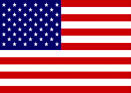
Francis Hopkinson, a writer, artist and a signatory of the declaration of independence designed the American Flag (never got paid for it though).
Design can help us remember
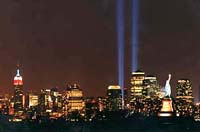
The towers of light by Julian Laverdiere and Paul Myoda, at this moment proposed as a temporary memorial down at Ground Zero, are a beautiful emotional response. They are ghost limbs; we can feel them even though they are not there anymore.
Design can simplify our lives

Everybody who had to buy tokens in the New York subway system would agree that the Metro card eased the way we go around the city.
Design can make someone feel better
After we designed the CD cover for the Rolling Stones there was quite some press interest in Europe and a number of Austrian and German TV stations came to New York for an interview.
This was just around the time my Mom was celebrating her 70 Birthday. I made a T-shirt saying "Dear Mom! Have a great Birthday" and wore it during the interview. The Austrian station agreed to air the interviews exactly on her Birthday.
Mom felt better.
Design can make the world a safer place
Cipro comes with a complicated, difficult to understand information pamphlet. It could also inform quickly and efficiently about when and how to take it as well as side effects.
Design can help people rally behind a cause
Robbie Canals poster series wheat pasted all over New York in the 80-ies probably spoke to the already converted, but showed me there are other people out there who are not happy with the administration. I guess I picked these posters over the hundreds or thousands of posters designers created that would qualify as an example because I saw those actually pasted on the street.
There is this entire subsection in design, the peace or environmental poster, where only hundreds are actually printed, only dozens go up in the street and the rest is distributed to design competitions.
This of course does NOT help people rally behind a cause, it only helps the ego of the designer.
Design can inform and teach
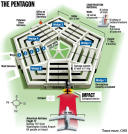
From the abstract geometric signs and animals of the cave paintings to the graphs in the New York Times, designers give us a better understanding of the issues.
Design can raise money

As a stand in for all the promotions and ads that raised money for Non-Profit organizations I am showing here the Breast Cancer symbol which made a an impressive amount of money for cancer research.
Design can make us more tolerant
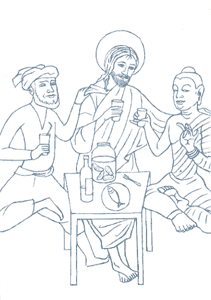
Russian designer Andrey Logvin simple poster called Troika speaks for itself.
Winter Sorbeck, design teacher and fictional main character in Chip Kidd’s new novel The Cheese Monkeys, says at one point: Uncle Sam is Commercial Art, the American Flag is graphic design. Commercial Art makes you BUY things, graphic Design GIVES you ideas.
If I’m able to do that, to give ideas, that WOULD be a good reason to get out of bed in the morning.