
Jan van Toorn, Critical Practice
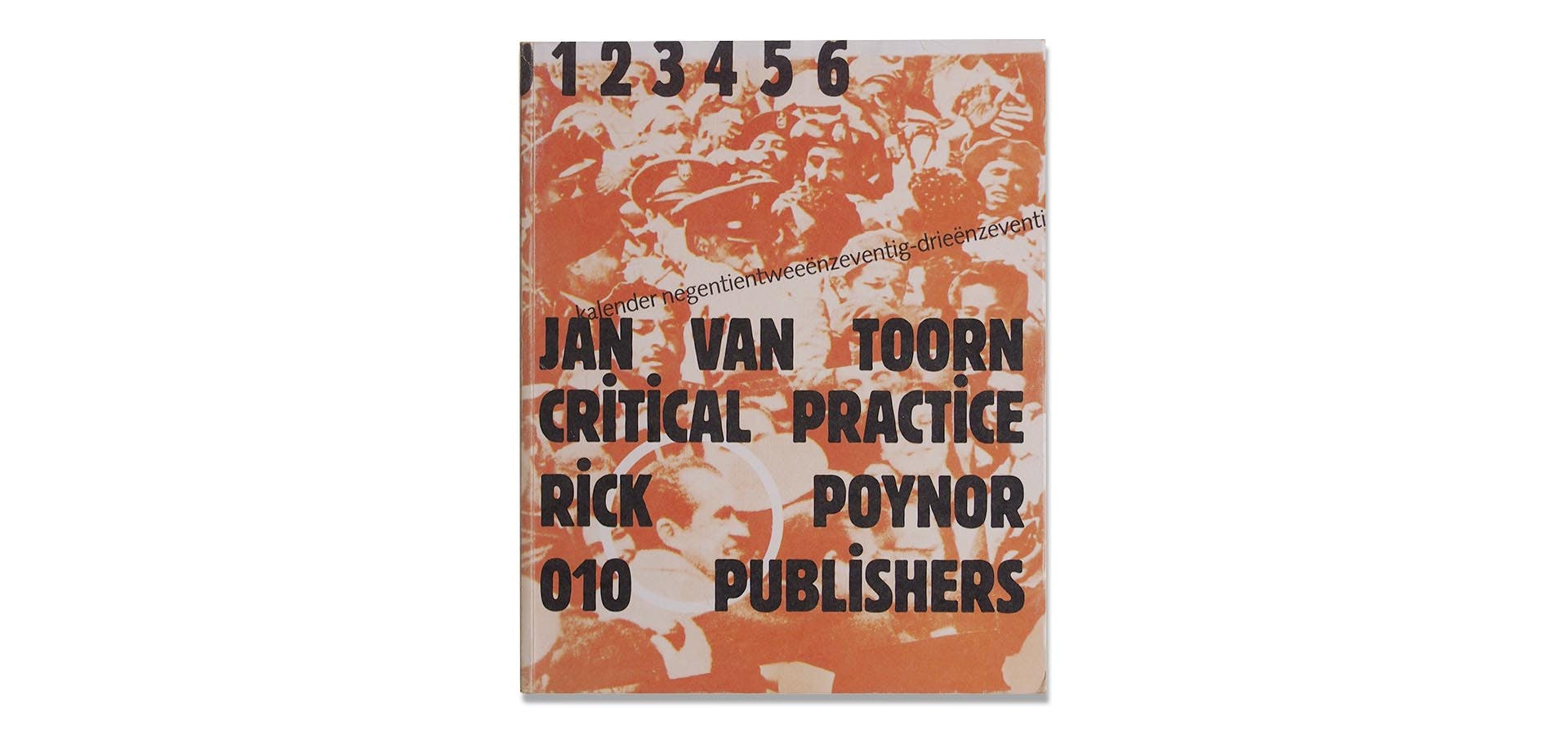
Jan van Toorn (JvT) represents a rarity: a radical designer with a long, steady career and an international reputation as both a designer and educator. JvT stood in counterposition to Wim Crouwel, another designer that dominated the 1960’s and 1970’s in the Netherlands. Crouwel, the co-founder of Total Design, advocated an objective, functional and systematic approach to graphic design, while JvT’s style is personal, confrontational and highly idiosyncratic.
JvT takes an interest in all forms of propaganda, manipulation and dissemination of information. From the 1970’s on, his priority has been to make the viewer of his design aware of the mechanics of manipulation. His work includes subversive ‘dialogic’ elements (JvT used the term ‘dialogic’ to describe interaction with the viewer of design) which are deliberately provocative and unfinished. Active also as a theorist, he observed: ‘In one way or the other, the public must remain in a position where they can measure the motives of the producer and mediator that lie behind the product, against their own experience of the world.’ JvT favors expression which stimulates the reader, rather than beautiful compositions and sleek forms. As a result, his work requires the viewer to have the ability and willingness to interpret the work.
[signup]Knowing that it could be risky to accept such a designer’s descriptions of his own works at face value, author Rick Poynor chose a more effective way to describe JvT’s work: instead of describing its appearance or speculating about the rationale behind it, Poynor looks in detail at JvT’s reading list. The idea is simple: since JvT is highly concerned with cultural and political theories and immersed himself in the world of Brecht, Chomsky, Debord, Deleuze, Eco, Enzensberger Godard, Habermas, Marx and Schklovsky, studying these sources of inspiration reveals a lot about his development, and it is interesting to see how particular books manifest themselves later on in the actual work. Poynor points to crucial books that JvT has read and presents their main arguments at length. For example, the German poet and cultural critic Enzensberger and his idea of ‘repressive and emancipatory media’ had a profound influence on JvT’s later way of thinking about design.
The ten chapters of the books serve to organise the book into thematical parts, though the book is also knit together by chronological progression. The titles of the chapters (Visual Reporting, Anti-house Style, Critical Practice, Deschooling Design, Styles of Representation…) give a good idea of what is discussed. Poynor’s text is squeezed between two chapters, and while in most cases the mentioned work is on the same page as the text, in other cases the decision to concentrate the main text of the book in one chapter results in paging through the entire book to find the work referred to.
Poynor documents at length the important and at times also amusing debate between Wim Crouwel and JvT, including Crouwel’s ‘correction’ of JvT’s 1974 calendar. These exchanges present two irreconcilable approaches toward design which have now become landmark moments in Dutch graphic design history.
[social]As in the two previous books in the series (Otto Treumann, Willem Sandberg), the designer of the book is also credited for ‘image-editing’. Designer Simon Davies mimics JvT’s characteristic design elements: for the main text of the book he uses loosely-spaced Univers 55 (a reference to the typography of Dutch Art + Architecture Today magazine where JvT determined the trial text setting by showing it to his neighbours and asking what they preferred). For the chapter dividers Davies used large, forced justified, caps-only quotations (mostly by JvT), similar to JvT’s treatment of type on late posters for the Jan van Eyck Academy. Following JvT’s habit, the pages use very narrow margins pushing the text to the edge of the page. Finally, to emulate the roughness of JvT’s use of images (see for example his calendars from 1976-77 for Amsterdam-based printer Mart. Spruijt), Davies avoids using discernible grids, but prefers using scrapbook-like compositions, cutting out photos with deliberate clumsiness. The reproductions of JvT’s works are on a neutral grey background, with visible pins attaching posters, or human hands holding books. While is it difficult to discuss the appropriateness of these design choices, the physical aspect of the book is not up to the standards of the designer that Davies is paying tribute to. With the text of captions extending far into the inside margins, ‘perfect’ binding is not the right choice. One doesn’t have to go far to find an example of better : a book from the series Sandberg, Designer and Director of Stedelijk, using the same format, does what a book should do — it lies flat when opened, accomodating the use of narrow margins — and it was designed by JvT.
JvT’s work undoubtedly deserves to be studied critically, and this book is not only a commendable contribution to design history, but a rare example of a graphic design monograph that not only celebrates forms, but comprehensively presents a body of work deeply engaged in issues of social consciousness. The design community desperately need a model to look up to, someone who balances the number of designers operating in the commercial sector. We are even willing to tolerate the occasional ambiguities. There simply are not many designers who openly question the client’s briefs, challenge and confound expectations, and moreover manage to infiltrate their client’s work with their own personal and political agenda.